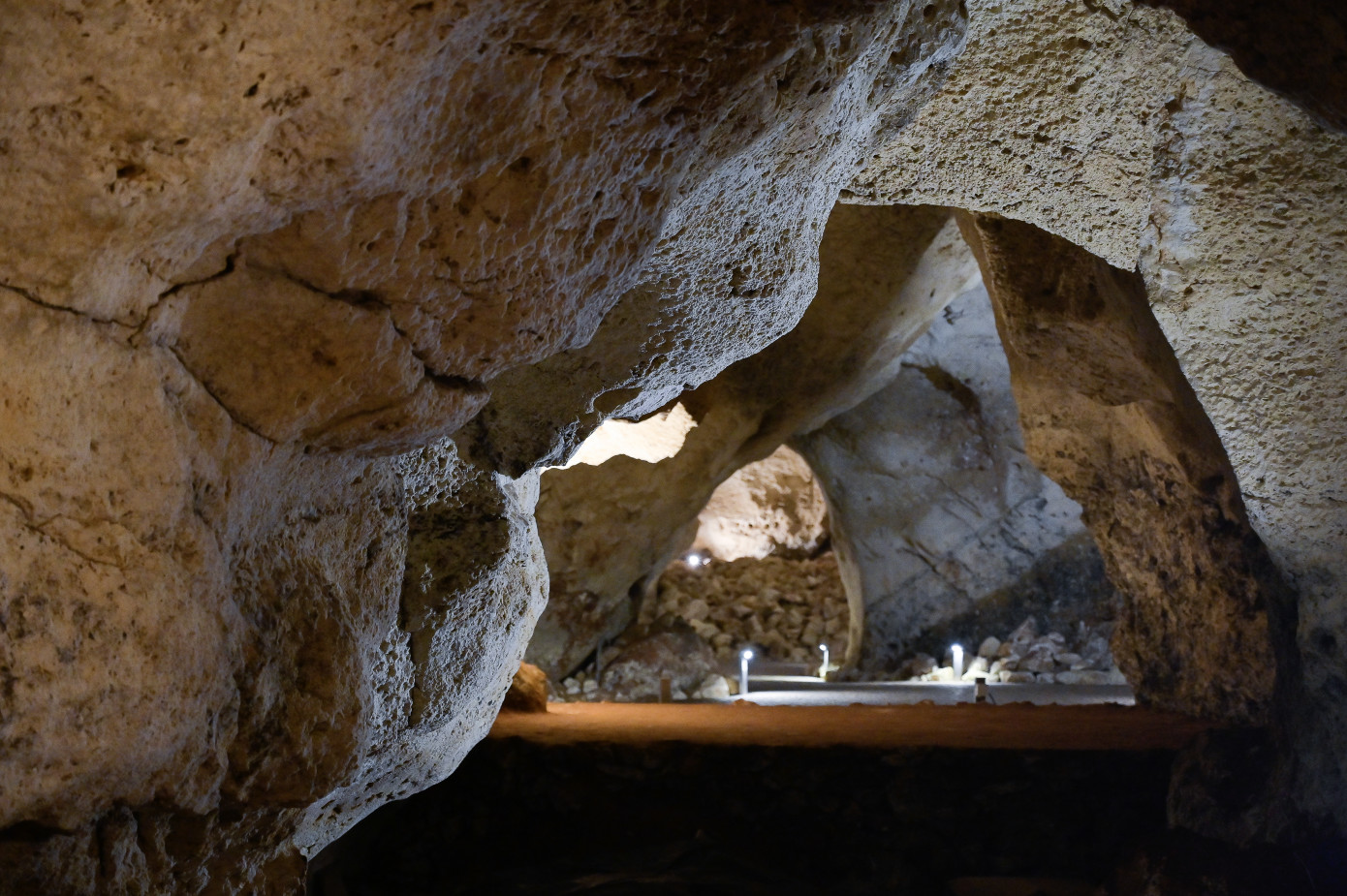
Step into the enchanting world of Tavrida Cave, an underground city filled with streets, alleys, main roads and intersections. This extraordinary cave, once home to prehistoric predators, offers a mesmerising experience. You will be captivated by the magical ambience, the delicate limestone walls sculpted into rounded shapes over millions of years, and, the unique archaeological finds that make this place truly one-of-a-kind.
A cave in reverse
Descending into the cave, you’ll find that space and time seem to shift. Your every cell takes in clean, moisture-rich air, and time feels as if it stands still. Cave guides often joke that they appear much younger than their years because the unique underground environment slows down the biological clock, helping to preserve youthful looks.
Crimea, with its 2,000 caves currently on the map, is renowned for its subterranean landscapes, believed by some to be part of a single expansive system of underground corridors extending beyond the peninsula. The list of caves is continually growing, showcasing the region’s rich geological diversity. One of the most remarkable recent discoveries is Tavrida Cave, located near the village of Zuya, in the Belogorsk District. Uncovered during the construction of the Tavrida Motorway in 2018, this cave has become a unique treasure for speleologists and palaeontologists.
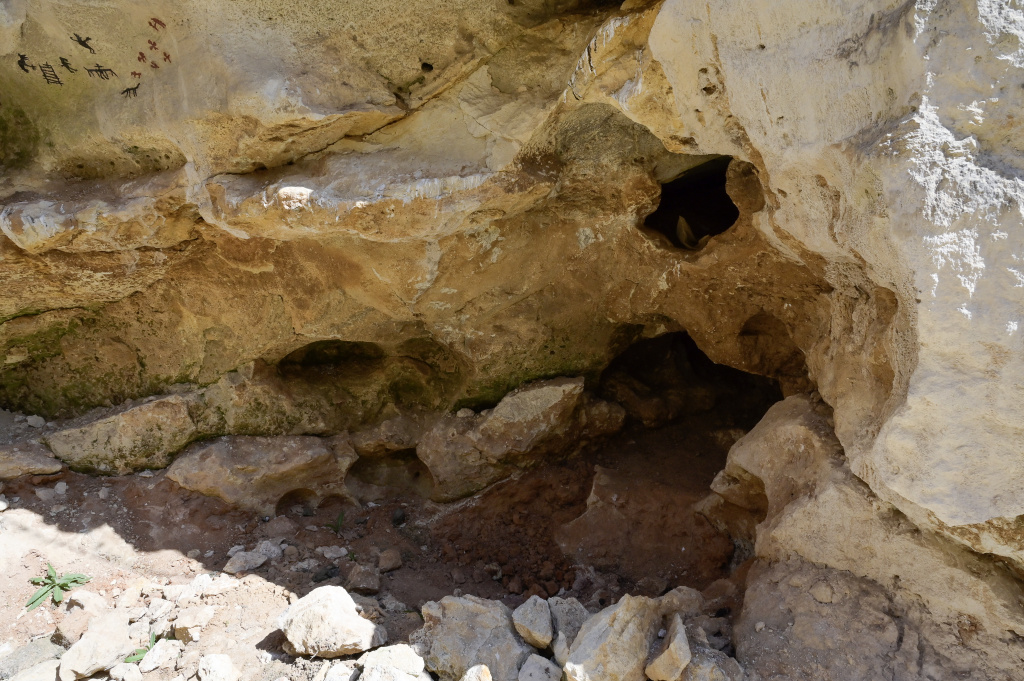
- “When the cave was discovered, it was 14 metres deep. It was an absolutely pristine place, where no man had ever set foot,” says Gennady Samokhin, Deputy Director for Research of the Tavrida Cave complex.
Even though a busy motorway runs right above the cave, the cave remains silent. Builders and scientists have installed 96 bored piles into the cave walls, supporting a robust 1.5-metre foundation that serves as a bridge beneath the road.
They successfully preserved this unique find, transforming it into the Tavrida Cave Research Speleological and Paleontological Complex. This preservation effort was crucial, as the cave contains ancient fossil cave fauna dating back 1.5 to 1.8 million years, remarkably unchanged to the present day.
− According to guide Yekaterina Samokhina, this is the warmest cave in Crimea, with a year-round temperature of +13℃, and humidity exceeding 99 percent. Unlike typical caves, Tavrida Cave does not have stalactites, stalagmites, or other formations usually found in caves. It is known as “a cave in reverse,” because it was formed fr om bottom to top through artesian processes. Once a large artesian basin, the water, under pressure like a geyser or a fountain, forced its way upward, creating wells, domes and other negative circular forms. It is quite soft and almost dry.
Today, the total explored length of Tavrida Cave stands at 2,050 metres, with a tourist route spanning 485 metres. The cave features lofty vaults, occasionally reaching heights of up to 15 metres. Remarkably, its wide passages, absence of steep flops and paving stone flooring render it accessible to wheelchair-bound visitors and mothers with young children in strollers. Yekaterina suggests that the cave will return to its pristine state once the paving is removed.
Explore Tavrida Cave with a one-hour guided tour, followed by a visit to the museum showcasing fascinating discoveries. Marvel at ancient finds on display, including paintings created with clay found in the cave.
Open daily fr om 9 am to 4 pm, without break periods.
Ticket prices
Starting May 1: children 500 roubles, adults 700 roubles.
Location: Zuya, Republic of Crimea.
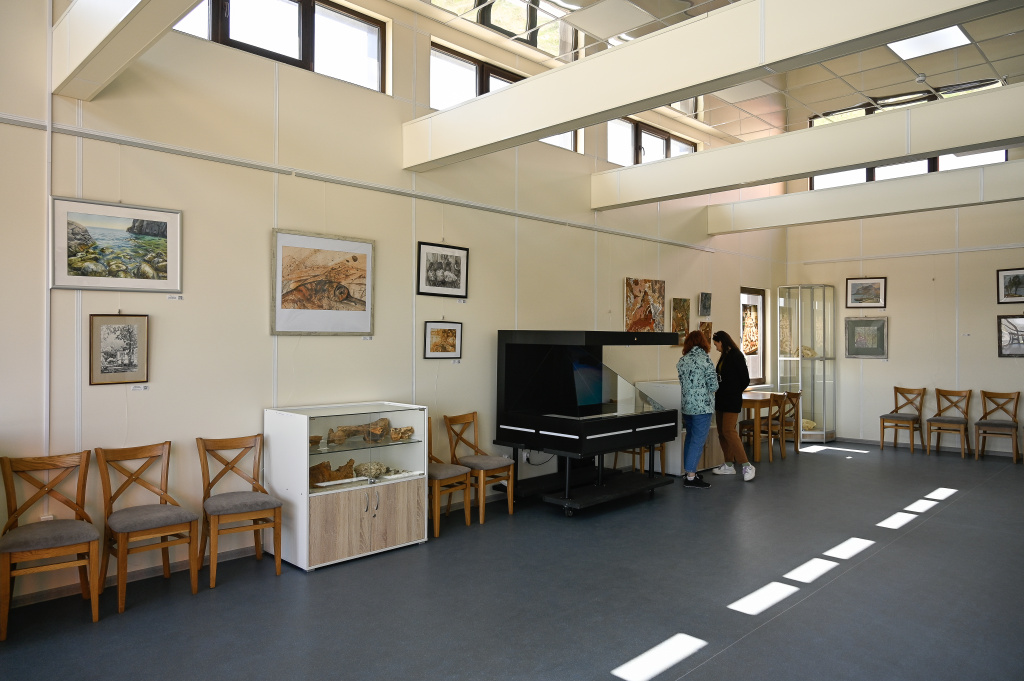
If you go to the left...
Tourists begin their cave exploration journey by following the path that goes to the left.
− For over a million years, Tavrida Cave was home to a vast colony of bats. Since the cave was sealed all that time, bat droppings combined with inorganic limestone, forming new types of minerals.
− Thirteen types of minerals previously unseen in Russia have been discovered in the cave. One of them is being studied by scientists, who believe it was discovered for the first time ever, the guide said.
Tavrida Cave boasts a wide array of minerals, including kingsmountite, robertsite, whitlockite, apatite, gypsum, and goethite.
Marvel at the captivating rock formations crafted over time by the bats within the cave. Among them, the vault known as The Heart of Tavrida is shaped like a heart, while another, The Globe Upside Down, strikingly resembles an overturned globe, featuring clearly discernible boundaries of Russia, India, China, and even Crimea.
The enchantment of Tavrida Cave extends beyond its natural wonders. Children are invited to unleash their creativity by drawing on the walls with ultraviolet flashlights, a unique experience wh ere bright green fluorescent drawings mysteriously appear under the beam of light and immediately disappears.
The cave is an acoustic wonder wh ere no echo can be heard. The porous limestone naturally traps sound, fully absorbing it, as if you were inside a vast recording studio. It is a challenge for many musicians to play music in a place that has no acoustics. The sound must be crystal clear, and every sound out of tune will be instantly discernible. Musicians fr om the Crimean State Philharmonic often perform on the small stage of the cave.
Fascinating facts about Crimea’s caves
Crimea’s largest and most picturesque cave, the Marble Cave, spans an impressive 270,000 square metres. The karst formations here are the largest in Eastern Europe.
The Soldatskaya Cave is the deepest and the most meandering cave in Crimea. It features a fascinating labyrinth of wells, inclined passages, grottoes and narrow horizontal corridors. The cave also contains an underground river and lakes. reaching a depth of 517 metres.
The Red Cave, or Kizil-Koba, holds the title of the longest karst cave, with a total length of passageways exceeding 26,000 metres.
The Tarkhankut Cave is Crimea’s lowest cave, located 10 metres below sea level.
Perched on Chatyr-Dag Mountain at an altitude of 1,490 metres above sea level, the Treshchinnaya (Crack) Cave is the highest cave in Crimea.
The largest series of U-bends can be found in Alyoshina Voda Cave, featuring six bends ranging in length from 3 to 100 metres and 1 to 17 metres in depth.
The Cascade Cave is known as the most dangerous cave in Crimea. It has a history of five recorded accidents, two of which were fatal.
Estimated to be about five million years old, Tavrida Cave is the oldest karst cave.
Little-known caves of Crimea include Lisiy Khvost (Fox Tail) in the Wolf Cliff, Agarmysh Mount; Pogreb (Cellar) on Mount Shpil near the Simferopol Quarry; Habazi-Khosar and Lestnichnaya (Staircase) on the yayla (mountain pasture) of Chatyr-Dag Mountain; Syundyurlyu-Koba in the Baidar Valley. There are also Mushinaya, Grina, Fassa, Mamina, Kilse-Chekh, Karani-Khoba, Tumannaya, Boyaryshnikova and Hadjikhoba caves, as well as Druzhba on the Karabi-Yayla mountainous massif. caves.
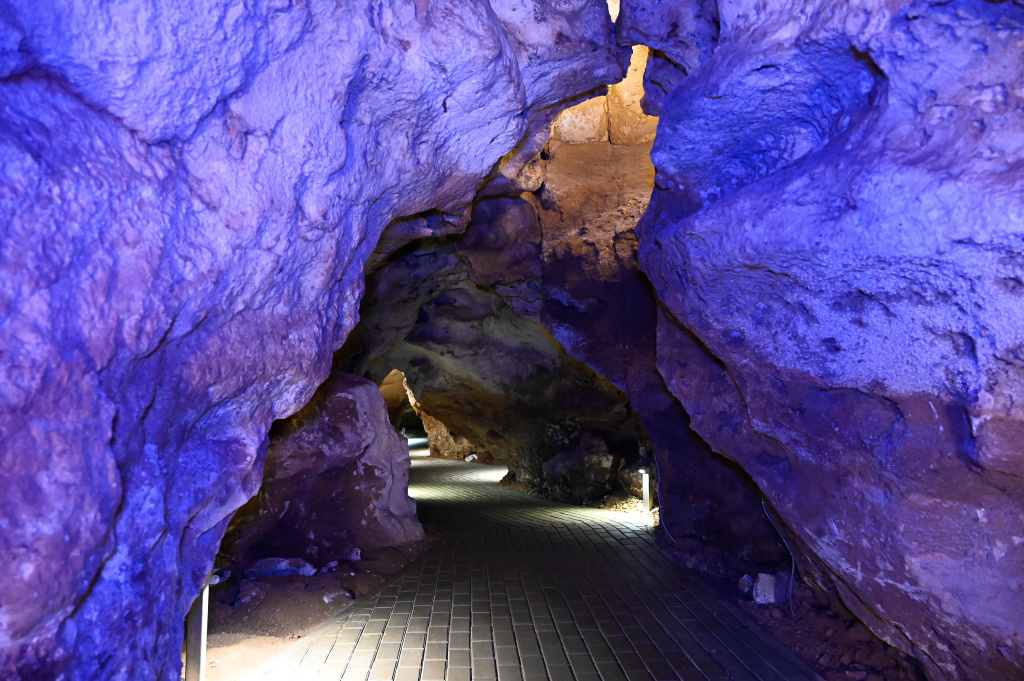
If you go to the right…
The right portion of this ancient cave was once home to predators. Archaeologists have uncovered nearly 500 kg of bones, including those of southern elephants, antelopes, horses, scimitar-toothed cats, hyenas, camels, porcupines, and even a giant ostrich that stood four metres tall.
More than a million years ago, the cave was inhabited by an array of fascinating creatures such as the giant hyena Pachycrocuta, the scimitar-toothed cat Homotherium, the Etruscan bear, the giant porcupine, the prehistoric rhinoceros Elasmotherium, the giant camel, the Stenonine horse, antelopes, Eobison, and the Leptobos bull.
Archaeologists also discovered a small recess in the cave that served as a “canteen” wh ere hyenas and other predators brought their prey. This area is rich with the bones of large animals.
Adrenaline and tranquillity
With over 1000 caves, Crimea offers a captivating array of subterranean wonders. These range from modest 5-metre to 10-metre deep pits to vast underground cavities stretching over many kilometres. The beauty of these hidden realms is revealed only to the most determined and adventurous travellers. While some caves require special knowledge and equipment, making them inaccessible to ordinary tourists, there are options for beginner cave explorers as well. For those just starting their spelunking journey, a descent into the Gugerdzhin cave/well is highly recommended.
Why go down a cave in the first place? What drives people to venture into the depths of the earth?
− According to Gennady Samokhin, there are numerous motivations ranging from research to sports. Caves are captivating worlds, offering an extreme and unusual setting that fosters unique relationships among fellow explorers. Historically, monks sought the solitude of caves to look deep within themselves.
Renowned traveller Fyodor Konyukhov wanted to spend two weeks in the Red Cave and asked us to set up a camp for him there. Many people share this fascination. I am more interested in discovering new caves. I’ve uncovered a couple hundred caves and many new galleries in my lifetime. The era of great geographical discoveries continues below the surface, as there is much to uncover underground despite our extensive knowledge of the world above.
Text: Irina Gulivataya
Photo: Gala Amarando