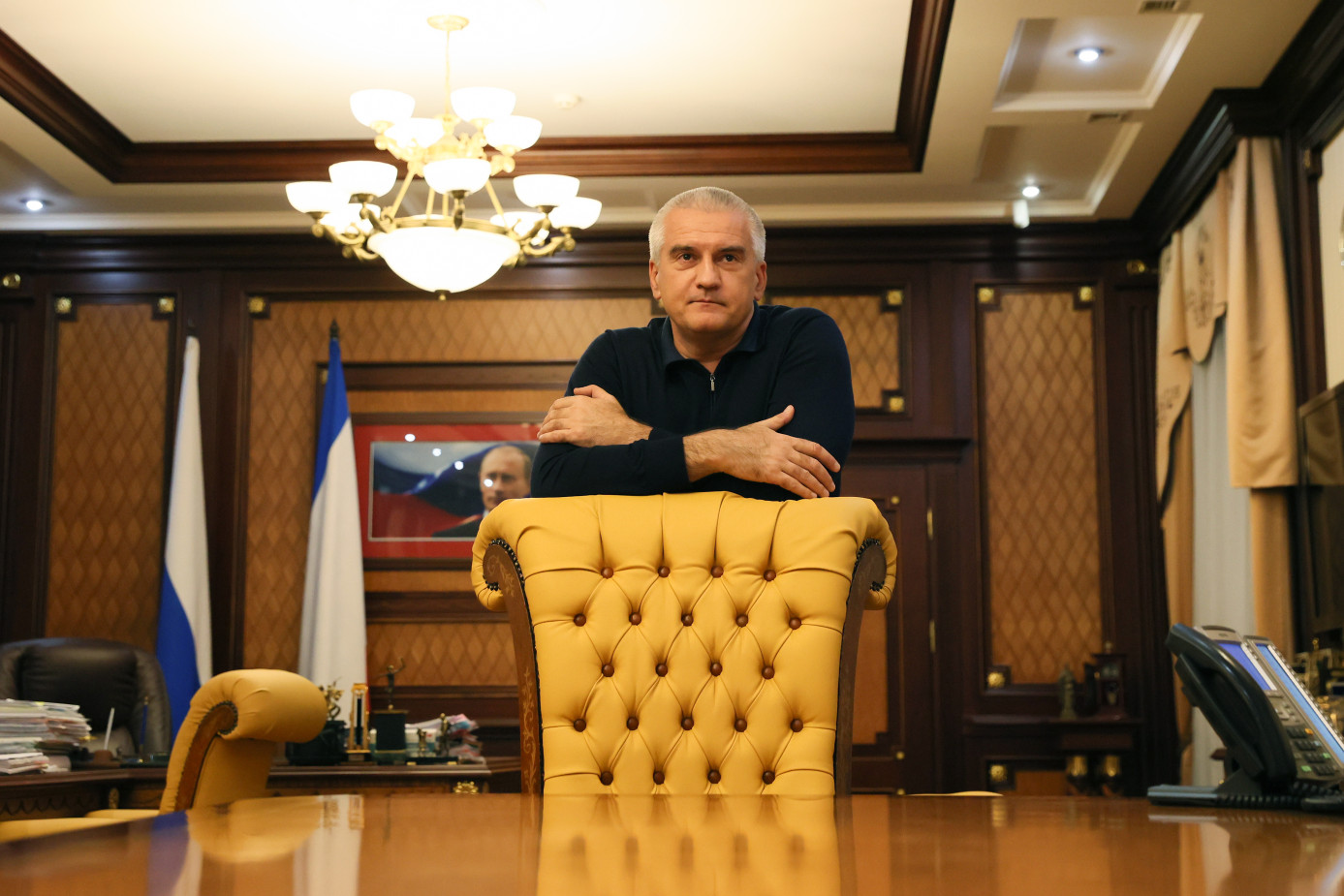
We decided to ask Sergey Aksyonov questions beyond the usual agenda. What would the regional head delegate to artificial intelligence? How does he handle making wrong decisions? Which questions fr om journalists does he dislike most? Find the answers to these and other unconventional questions in this interview.
— Sergey Valeryevich, let's start with artificial intelligence—it's unavoidable these days. If you, as Crimea's leader, could delegate one of your functions to AI, which would it be?
— I've told colleagues repeatedly that a significant portion of officials could easily be replaced by robots, in the best sense (laughs). The key advantage of artificial intelligence and robots is that while they may be imprecise, they never deliberately lie. That's a major achievement.
I always tell my colleagues: if you realize an official has started lying, there's no point continuing to work with them, because the situation will only worsen over time and create additional problems. But technology, mechanical elements, artificial intelligence, robots—they can't lie, and that's their advantage. They could be used in handling citizens' appeals, wh ere honesty and responsibility are most crucial. Perhaps someday we'll get there.
But of course, nothing and no one can replace a human being. There are many details you need to delve into, to process personally. To understand how you would act to make things better for your loved ones. Artificial intelligence is precise, but not always just.
— If you were asked to write one rule that every leader should know and follow, what would it be?
— There are two such rules. First: if you want something done well, do it yourself. Second: if you want to solve a problem, don't trust anyone—trust only what you've seen and heard yourself. When colleagues report something to me, I always ask: did you see it yourself? No, I didn't see it myself. That's it, I don't believe it. Go to the site, and when you see it yourself, call me and tell me how things really stand.
Therefore, to avoid mistakes when citizens ask for help solving problems, I always say: do for people as you would for your closest loved ones, as you would for your own mother. And you won't go wrong.
The rules are all simple: never delegate an important matter—complete it yourself. This is despite the fact that managers must be able to organize team work and so on. But still, nothing excludes personal involvement and interest in fulfilling all commitments and seeing things through to their logical conclusion.
— What do you do when you realize you've made the wrong decision, but it's too late to reverse it?
— I make another decision. But I never cancel my decisions, never go back on my word. Other decisions may be made that help achieve the set goal and ensure justice prevails.
— Do you generally make decisions easily, or does it depend on the situation's complexity?
— I make them quickly. I don't have the habit of deliberating for long. I'm a straight-A student in life, so I calculate quickly, make decisions quickly, take responsibility. I always value advice, other perspectives, never neglect them. But I'm convinced: all decisions made during on-site visits, after seeing everything firsthand, are the most correct.
— Which decision in 2025 was most difficult for you, and what did it perhaps teach you?
— You know, I don't have any like that. All decisions are the same. I mean, they all equally serve the interests of the state, the interests of the people. They vary in complexity, but for me there are no difficult decisions. They're all simple to me. Some just require a bit more time and personal involvement to implement.
When I need to resolve an issue quickly, I always call the specialist working on the ground directly. I say: "Petya, Vasya, run over and take a look." Half an hour later they call me: "Valeryevich, I've looked, we need this and that." That's it, we have a decision, great, let's go!
But if I start calling the bosses, a week later I might get a negative answer. That's why I have simple, direct communication.
Sometimes I tell colleagues: it would be easier for me to do without management altogether, without all the intermediate links. Direct contact with specialists would definitely increase the effectiveness of decisions made.
— What criticism of the government this year proved most useful? You have active social media presence. As journalists, we know the most effective mechanism is writing to Sergey Valeryevich on VKontakte. Perhaps there was something that helped solve an acute problem or correct a situation.
— I'm grateful to people and authorities, everyone who speaks out, has a different viewpoint fr om the leadership or from adopted laws and regulations. This is a normal process. I always say: analyze the situation. We take into account all appeals without exception. Even if you understand that a provocateur is writing, you know it's a provocateur, but they're reporting some important news—definitely react. Everyone has their own truth, but the truth is always specific.
There should be rational proposals. If you criticize—propose, that's all! What would you do in my place? That's why I value it and always say: criticize, challenge, suggest—we'll only be glad.
— Sergey Valeryevich, which questions from journalists do you dislike and why?
— I don't like questions on personal topics. When they ask: what do you do at home, what do you do in your free time?
There's work, wh ere I'm obligated to report all my steps, because my decisions affect the lives of many people. And there can be no secrets here—I say everything openly, as it is.
As for personal questions: "what time do you wake up," "what do you do," and so on—absolutely not. I tell everyone: I don't answer personal questions because it's my personal time. I practically don't have any, this free time, so there's no idle pastime either.
And generally, personal schedule should remain personal. Let at least this limited time remain personal.
Text: Elena Vitvitskaya