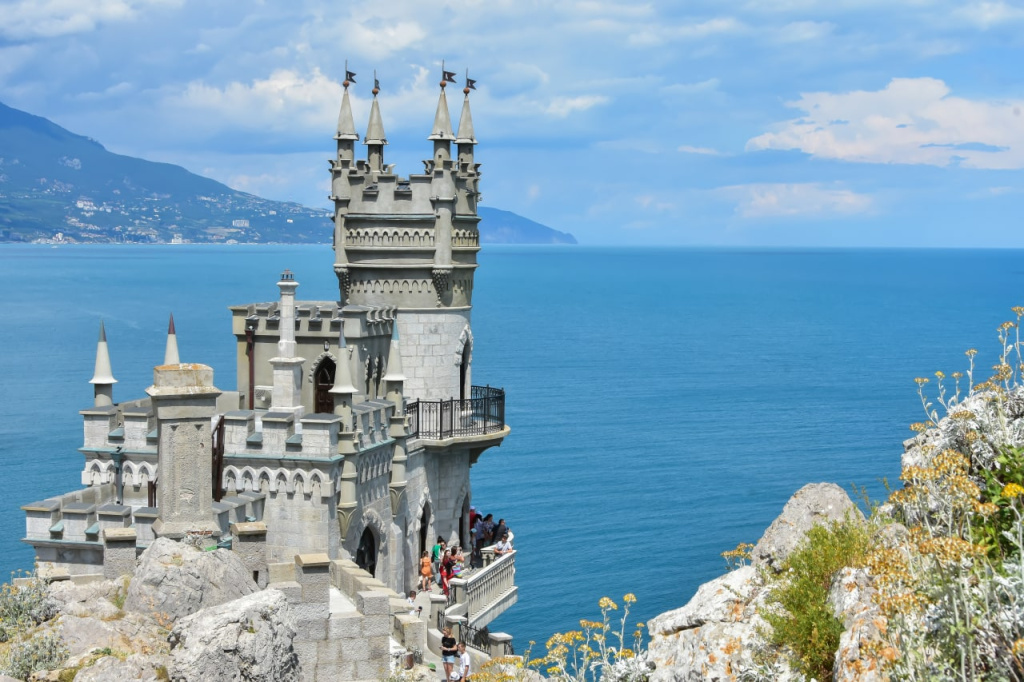
One of Crimea's most iconic landmarks celebrates 15 years as a museum.
A Palace of Art
Over its 113-year history, the Swallow's Nest castle has served as an industrialist's dacha, a restaurant, and even a private residence. But already at the dawn of the last century, this unique neo-Gothic structure perched high above the sea on the sheer Avrorina Rock had become Crimea's signature attraction. In 2011, republican authorities decided to transform the architectural masterpiece—long in need of restoration—into a museum, finally aligning its formal status with its informal reputation.
On July 22 of that year, the first art exhibition opened in the castle, marking the beginning of its museum life. It is fitting, then, that the 15th anniversary of this milestone is being celebrated with a new exhibition.
«With support from the Ministry of Culture, we have opened an exhibition of paintings from the collection of the Simferopol Art Museum. We are showcasing 23 works of painting and graphics by Western European masters from the 17th to 19th centuries. Among the most notable pieces, I would highlight 'Interior of a Renaissance Hall' by the Dutch master Gerard Houckgeest (17th century), which captures the elegance of pink marble columns and the strict rhythm of architectural elements—this is classicism. Romanticism is represented by works such as 'Aachen Cathedral' by Johann Gottfried Pulian, 'Interior View of a Cathedral' by Georg Carl Hasenflug (both 19th-century masters), and 'St. Lorenz Church in Nuremberg' by Hans Herrmann. The paintings I've mentioned all depict buildings in the Gothic style. The Swallow's Nest, meanwhile, was built in the neo-Gothic style—there's a dialogue between eras. That's why the exhibition is called 'Castle of Art,'» explained Alexander Levin, Deputy Director of the State Budgetary Institution «Swallow's Nest Castle.»
Renewed and Restored
As Deputy Prime Minister of Crimea Mikhail Nazarov recalled, after the peninsula's reunification with Russia, the castle was designated a federal cultural heritage site.
«From 2019 to 2020, a major reconstruction was carried out costing 87.5 million rubles. The work included facade restoration, reinforcement of the rock foundation, and the restoration of unique decorative elements. Since January 1, 2021, the palace has operated in its fully renovated building and has since welcomed more than 700,000 visitors, including some 260,000 from preferential categories and 120,000 children,» he noted.
The castle was also restored during Soviet times, but that was long ago—between 1967 and 1970. Before that, the building had been severely damaged during the famous Yalta earthquake of 1927 and remained abandoned for 40 years. The Avrorina Rock was also damaged and had to be reinforced by domestic mountaineers. However, over subsequent decades, part of the palace's foundation lost its support, which was only restored in our own time.
The Palace on Screen
Filmmakers, naturally, could not pass up such a rich backdrop as the Swallow's Nest. The palace can be seen in films such as Vladimir Grammatikov's Mio, My Mio, Krzysztof Gradowski's The Academy of Mr. Kleks, and even Jackie Chan's The First Strike.
But the castle left its most notable mark on Stanislav Govorukhin's Ten Little Indians, an adaptation of Agatha Christie's novel. To this day, the museum maintains a permanent exhibition dedicated to the film.
«Our local artist-sculptor Vladimir Shevchenko created figurines of ten little Indians in the style of the statuettes featured in the film. They are displayed in the spaces between our windows. But since the film is dark, and the Swallow's Nest is a positive place, there is a caption beneath the figurines stating that the ten little Indians will remain in the castle forever,» Alexander Levin shared.
He added that the positive energy the castle gives to visitors remains intact despite power disruptions caused by drone attacks in Crimea. Nevertheless, due to the introduction of an emergency regime in the republic, the institution has adjusted its hours: it is now open daily from 10:00 AM to 4:00 PM.
Historical Footnotes
In the 19th century, the name «Swallow's Nest» was already associated with a boarding house for the sick run by Adalbert Tobin on Cape Ai-Todor. Later, the dilapidated building was rebuilt. It acquired its present appearance in 1911–1912, when a plot of land on Avrorina Rock was purchased by German oil industrialist Baron Pavel Steingel. The design of the romantic castle, which resembles medieval structures along the Rhine, was commissioned from engineer and sculptor Alexander Sherwood.