This season, ten archaeological expeditions operated across Crimea. What remarkable finds did the researchers bring to light?
The expedition sets out
Despite certain logistical hurdles, the peninsula hosted not only Crimean scholars but also researchers fr om Moscow, St. Petersburg, and Tula, continuing a long‑standing tradition.
«By my count, ten archaeological expeditions worked in Crimea this year. Three of them conducted research on the Kerch Peninsula, several more on the southern coast. One expedition focused on Solkhat (south‑eastern Crimea), and we also managed to carry out excavations on the territory of Chersonesus. So, archaeological investigations this season, albeit on a modest scale, covered the entire peninsula,» says Dr. Vadim Maiko, Director of the Institute of Archaeology of Crimea, Russian Academy of Sciences.
Stones hold their secrets
One of the most captivating lines of research into Crimea’s rich history is the study of the medieval cave city of Eski‑Kermen.
«We have a major joint project with the National Research Centre ‘Kurchatov Institute’. We are analysing artefacts recovered during the excavations. For me, one of the most exciting directions is the study of the frescoes in the Church of the Dormition – a cave church carved into one of the rocky cliffs of Eski‑Kermen. We took minuscule samples – just a few millimetres – to determine which pigments were used in the paints. The results turned out to be extremely interesting. We are currently analysing them and plan to publish our findings,» says Elzara Khairedinova, Deputy Director for Research at the Institute of Archaeology of Crimea, RAS.
Powder and rouge in the name of science
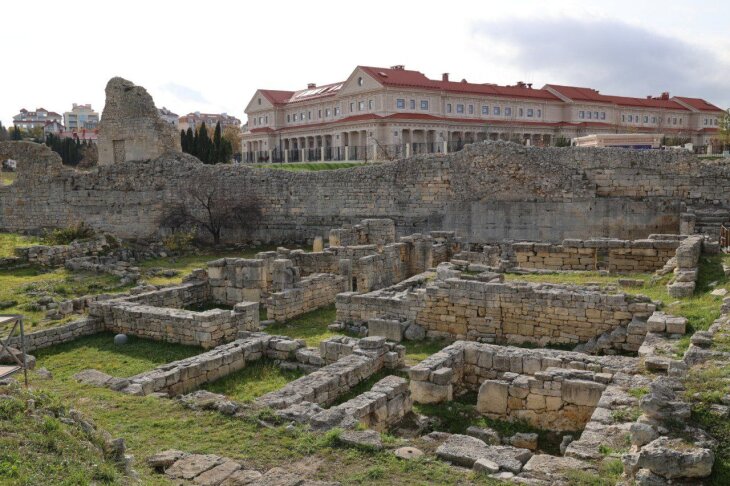
Viktor Vakhoneev, Senior Researcher at the Institute of the History of Material Culture, RAS, and PhD in History, reported that due to logistical complications, several expeditions had to be postponed by a couple of months. Logistics are now being restored, permits have been obtained, and the main effort is concentrated in south‑western Crimea. The researchers continue their project on the southern suburb of Chersonesus: despite the fact that this site has been under investigation for two hundred years and has seen the work of leading specialists, the team has managed to supplement and refine the existing data.
A couple of years ago, archaeologists discovered a unique burial here – the tomb of an eighteen‑year‑old girl named Annion, complete with a stele bearing her image. The monument has now been restored and is located near the Museum of Antiquity and Byzantium. With enormous effort, the tomb was relocated using the method of anastylosis – a painstaking process in which every single stone is moved and set back in its original place. Only now have the researchers begun a full analysis of this complex.
«The tomb contained an enormous number of adornments, pottery, glassware, and pyxides – small bone boxes for powder and rouge. In two of them, we found powder that is 1,900 years old. We also discovered luxurious hairpins whose finials are shaped like Venus Anadyomene emerging fr om the sea foam and wringing out her hair. We have found parallels for our finds in French and Italian sites,» Viktor Vakhoneev recounted.
Thanks to such rich findings, historians have been able to view the elite burials of the Roman‑period nobility who resided in Chersonesus from a fresh perspective.
«We even managed to reconstruct what the suburban space looked like in Antiquity. These were funeral streets. Interestingly, exactly the same kind existed in Central and Northern Italy, in Southern Gaul, and in Asia Minor. All this once again confirms that we were part of a single civilisational space of the ancient world,» the scholar notes.
The sea devours antiquities
The second major project, actively pursued at the museum‑reserve «Tauric Chersonesus,» is linked to underwater excavations. For the first time, the museum received a grant from the Russian Science Foundation for this work, allowing researchers to begin surveying the coastal area at a new level.
«We are examining the coastal zone at the intersection of geophysics, electrical resistivity tomography, archaeology, and geology. Specialists are creating digital casts of the coastline using different methods and then combining them. This helps identify losses along the northern shore of Chersonesus. Such an approach will allow us to predict the preservation state of the monument and determine priority areas for excavation in order to save endangered sites. Only about a dozen specialists worldwide are working on similar topics – in Greece, the United Kingdom, and the United States. And we are part of this sel ect circle of experts,» notes Viktor Vakhoneev.
In this way, Crimea is developing a unique methodology that will later be tested on other coastal monuments of the Black Sea region that are under threat fr om landslides or abrasion. And there are many of them: the ancient city of Kytaia near Kerch, the settlement of Myrmekion, Belyaus, the Kulchug settlement on Tarkhankut, and so on.
A greeting from the Golden Horde
A kind of new renaissance is underway in Crimean archaeology concerning the Golden Horde period and the archaeology of the Crimean Khanate.
«From 2015 to the present day, we have excavated a great many extremely interesting sites from the Crimean Khanate period – both rural and urban. The work in Bakhchisarai was particularly large‑scale. This has effectively created a new direction in medieval archaeology, which is now actively developing. God willing, we will soon publish the vast array of materials we have obtained,» says Vadim Maiko.
For instance, the settlement of Solkhat – the capital of the Crimean ulus of the Golden Horde – is a unique monument not only for Crimea but for the entire territory of the former Golden Horde. The State Hermitage Museum plays a key role in the research: it acts as the lead organisation for the joint Old Crimea archaeological expedition. The Hermitage has been conducting work on the territory of the medieval settlement of Solkhat (modern Staryi Krym) since 1978 – so the expedition’s fiftieth anniversary is not far off.
«Staryi Krym is a city literally built on top of the ancient settlement. This seriously complicates the work of archaeologists and, to some extent, the lives of local residents: by law, nothing can be built on the territory of a monument without preliminary archaeological research. Before constructing anything, you first have to conduct excavations. At the same time, the archaeologists themselves face difficulties – they cannot always gain access to the sites they need. For example, the keness and some mosques are located on private property, which is hard to access. And as a result, these monuments are gradually deteriorating,» notes Emil Seidaliev, Senior Researcher at the Institute of Archaeology of Crimea, RAS, Head of the Department of History at the Crimean Engineering and Pedagogical University named after F. Yakubov, and Head of the Old Crimea Archaeological Expedition.
Nevertheless, thanks to the fact that Crimea is now within the legal framework of the Russian Federation, the territory has finally been officially registered.
«We managed to list it as a single monument, clearly defining its boundaries – so now it is clear wh ere development work is permissible and wh ere it is absolutely forbidden,» the specialist says, referring to one of the important victories for the archaeologists.